
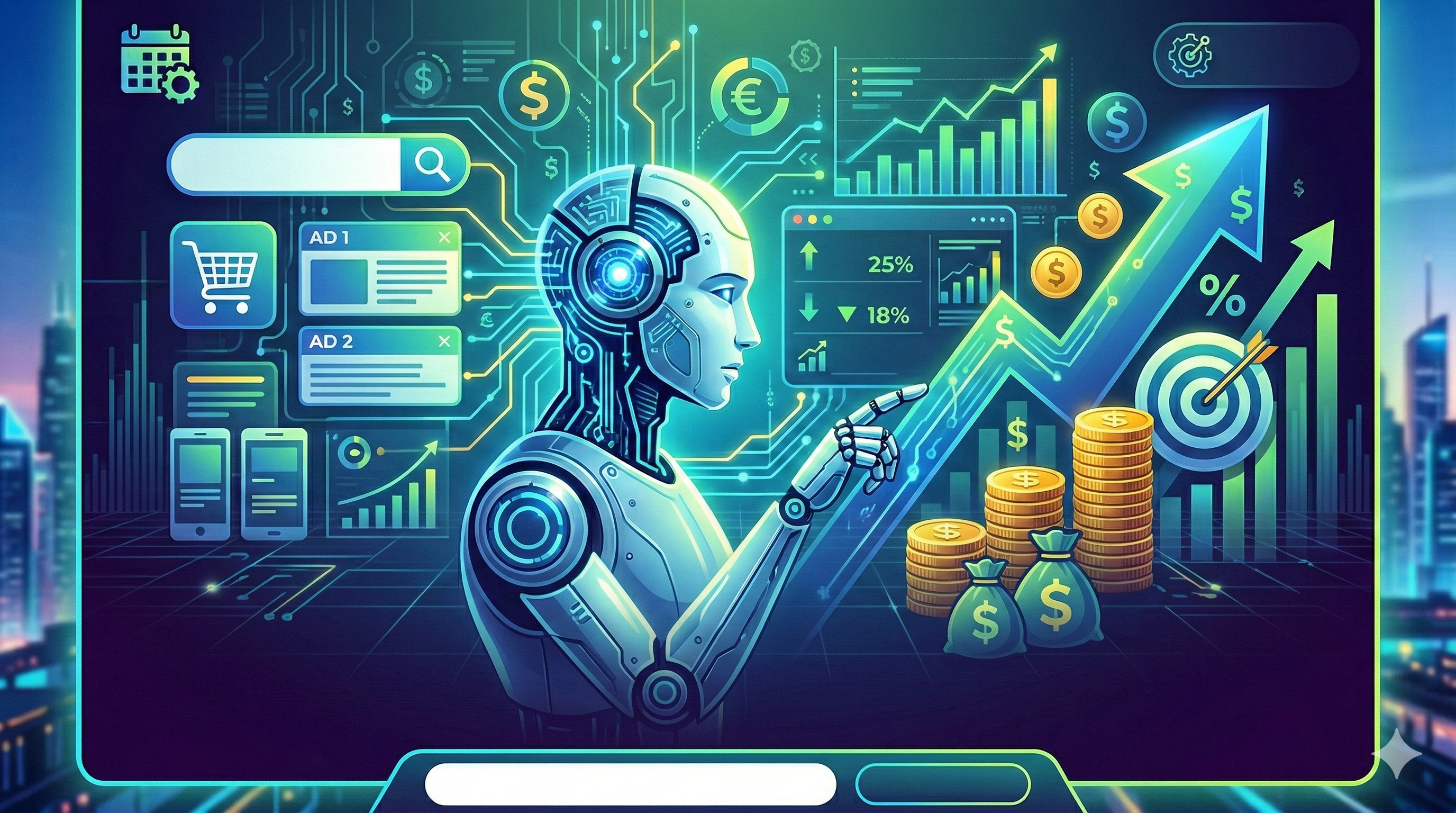
Pay-per-click advertising has always been about precision. The more accurately you target, bid, and optimise, the better your return on investment. But manual optimisation is no longer enough. Platforms like Google Ads and Meta Ads have evolved into AI-driven ecosystems where automation is not optional — it is the core engine.
If you are still relying on manual bidding, broad targeting, and occasional campaign tweaks, you are already behind. AI-powered PPC is not a trend; it is the new standard. The real question is whether you are using it strategically or blindly trusting algorithms without direction.
Let’s break down how to maximise ROI with smart automation — not random automation.
Artificial intelligence in PPC works by analysing massive amounts of data in real time. It studies user behaviour, search intent, device usage, location signals, time patterns, and hundreds of other micro-signals to predict the likelihood of conversion.
Here’s what AI can handle better than humans:
But here’s the reality: AI is only as good as the inputs you give it. Poor tracking setup, unclear goals, or weak creatives will produce poor results — just faster.
If you expect automation to fix a broken strategy, you will waste money quickly.
Manual CPC bidding is outdated for performance-driven campaigns. AI-based bidding strategies such as:
allow platforms to predict conversion probability per auction.
However, many businesses make a critical mistake: they switch to automated bidding without sufficient data. Smart bidding needs historical conversion data to learn. Without at least 30–50 conversions per month (per campaign), you are feeding the algorithm weak signals.
If you are a growing business, work with a digital marketing company in Kerala that understands when to transition from manual to automated bidding — not just flip a switch because it sounds advanced.
Traditional targeting focused on demographics. AI-based targeting focuses on intent and behaviour.
Instead of manually selecting age, gender, and interests, AI analyses:
Tools like Performance Max campaigns and Advantage+ campaigns use machine learning to identify high-converting audiences you may never manually select.
But there’s a catch: if your conversion tracking is inaccurate, AI will optimise toward the wrong actions. For example, if form submissions are tracked but not filtered for spam, the algorithm may optimise for low-quality leads.
Automation amplifies both strengths and weaknesses. Clean data is non-negotiable.
Manually A/B testing two ads is slow. AI can test dozens of combinations of:
in real time.
Responsive Search Ads and dynamic creatives automatically assemble the best-performing combinations based on user intent.
But automation doesn’t replace strategy. You still need:
AI chooses the best version. It cannot create persuasion from nothing.
AI-powered systems can automatically shift budget toward:
This eliminates emotional decision-making.
However, full automation without monitoring can lead to overconcentration. For example, if one audience segment converts slightly better, the algorithm may aggressively prioritise it, ignoring long-term growth segments.
The solution is controlled automation. Set guardrails:
A disciplined digital marketing company in Kerala will use automation as a tool — not surrender full control to it.
AI cannot optimise what it cannot measure. If your tracking setup is weak, your entire automation strategy collapses. Most businesses think tracking clicks and form submissions is enough. It is not. AI needs high-quality conversion signals — actual revenue, qualified leads, sales value, repeat purchases — to make intelligent decisions. Enhanced conversions, CRM integrations, offline conversion imports, and server-side tracking are no longer advanced options; they are baseline requirements. If your data is shallow, the algorithm will optimise for shallow outcomes. Strong tracking transforms automation from guesswork into predictable growth.
AI-powered PPC fails when businesses misuse it. Automation does not remove the learning phase, and it does not compensate for poor strategy. If you constantly edit campaigns during the learning period, reduce budgets too quickly, or expect instant profitability, you interrupt the algorithm’s ability to stabilise. Another common failure point is weak landing pages. No bidding strategy can fix a page that does not convert. AI accelerates performance — both good and bad. If your fundamentals are flawed, automation will simply help you waste money faster.
Markets are becoming more competitive, and manual optimisation cannot keep up with AI-driven competitors. Businesses that adopt intelligent automation early gain lower acquisition costs, faster optimisation cycles, and better audience discovery. In competitive regions, working with a strategic digital marketing company in Kerala that understands how to combine local market behaviour with AI-based bidding and targeting can create measurable advantages. Automation done correctly is not about convenience; it is about scaling performance while competitors are still adjusting bids manually.
The AI-powered PPC system functions as a multiplicative marketing tool rather than serving as a quick solution to advertising. The automated system will increase your return on investment when your campaign structure, data quality and messaging components all function effectively. The system will increase your losses when your system components function at a low level. The successful businesses maintain control over their operations through precise goal setting and accurate tracking system development while providing high-quality data for their campaigns and using automated systems within established limits. Smart automation rewards discipline and strategy. Without them, it becomes expensive noise.