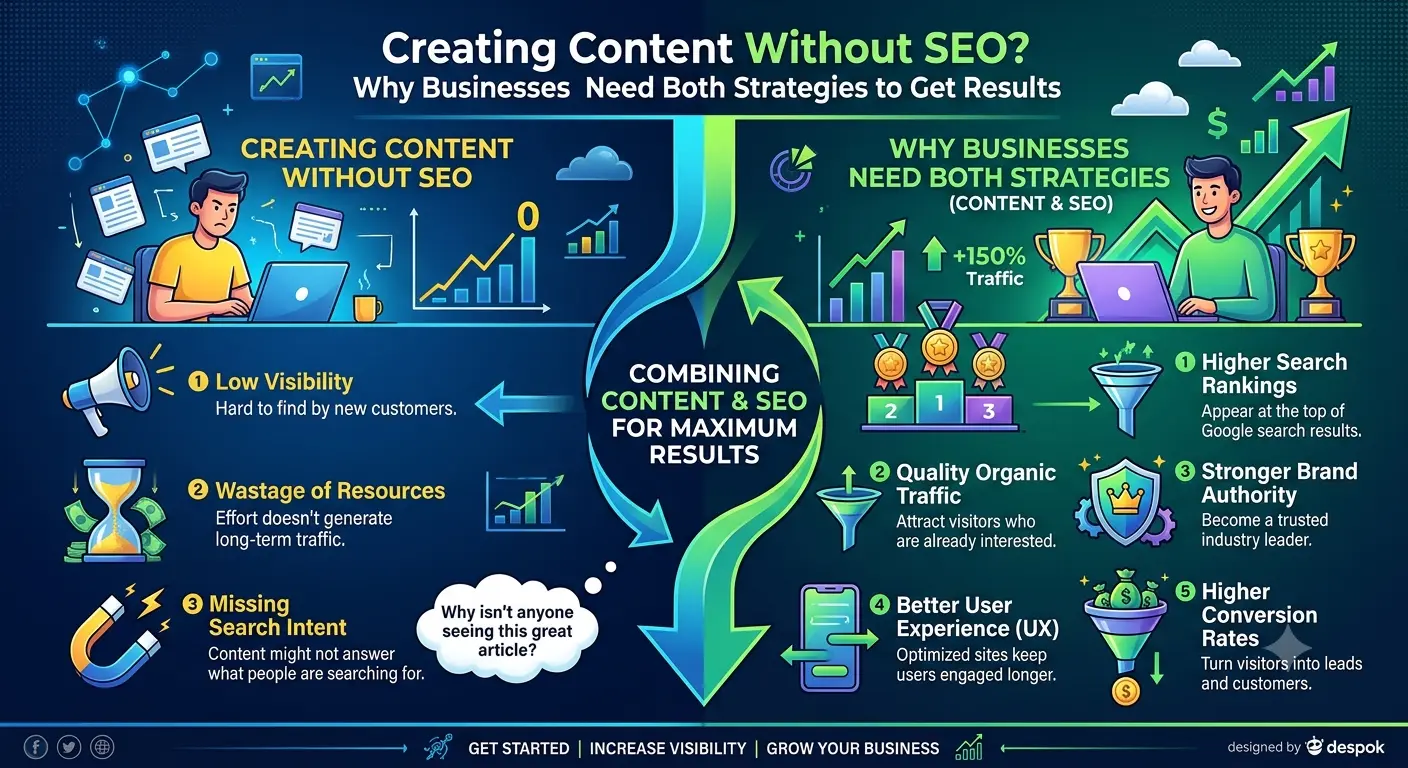
Creating good content takes time, research, and a clear understanding of what customers want to know. Businesses publish blogs, update website pages, and share useful information to attract potential customers. However, even well-written content can struggle to reach the right people when search engine optimization is overlooked. A useful article may answer every customer question, but if people cannot find it through search engines, its reach remains limited.
This is where content creation and SEO need to work together. Content gives people information, while SEO helps search engines understand that information and connect it with relevant searches. One supports the other, and neither should be treated as a separate activity.
At TrivLogic, the focus is on helping businesses build a stronger online presence through practical digital strategies. Investing in digital marketing services in Kerala can help businesses connect content planning with search visibility, website performance, and customer acquisition. Instead of publishing articles simply to keep a blog active, businesses need to create content that serves a clear purpose and supports measurable goals.
So, is publishing content without SEO a waste of time? Not necessarily. But when both strategies work together, businesses have a better opportunity to attract relevant visitors, answer customer questions, and turn website traffic into enquiries.
Quality content is important, but quality alone does not guarantee visibility. Search engines consider several factors when deciding which pages to display for a particular query. These include relevance, content usefulness, website accessibility, and other signals that help determine which results best meet the searcher's needs.
Imagine a company publishing a detailed article about choosing the right software for small businesses. The article contains practical advice, clear explanations, and useful examples. However, the page has a vague title, no clear heading structure, and no connection to related pages on the website.
The information may be valuable, but search engines and readers could struggle to understand its focus.
Common issues include:
Publishing more articles will not automatically fix these problems. A business could publish five blogs every week and still struggle to attract relevant visitors. More content is not always the answer. Sometimes, the existing content simply needs better optimisation.
Search engine optimization helps businesses make their content easier for search engines to discover, understand, and present to relevant users. It starts before writing and continues after a page is published.
Keyword research identifies the phrases people use when looking for information, products, and services. It also helps businesses understand whether users want an explanation, a comparison, or a service provider.
For example, someone searching for SEO basics may want educational information. Someone searching for a digital marketing agency may be closer to contacting a provider.
Understanding this difference helps businesses create the right content for each stage of the customer journey.
On-page SEO improves the way information is organised and presented on a page. Important elements include:
These elements should support readability rather than turn an article into a collection of repeated keywords.
Even excellent content can struggle if search engines cannot access or index the page properly. Technical SEO helps address issues such as broken links, duplicate pages, incorrect canonicals, slow performance, and indexing errors.
Businesses looking for Search engine optimization services in Kerala should consider content quality and technical performance together. A strong article needs a website that allows search engines and visitors to access it without unnecessary difficulties.
Content marketing focuses on creating and distributing information that attracts and engages a relevant audience. SEO helps that information reach people who are actively searching for related topics.
When both strategies are aligned, content can support several business goals.
Greater organic visibility: Optimised articles have a better opportunity to appear for relevant searches.
Long-term traffic opportunities: Useful content can continue attracting visitors after publication, although results depend on competition, relevance, and ongoing optimisation.
Stronger customer understanding: Articles that answer real questions help potential customers evaluate their options before contacting a business.
Better website navigation: Internal links connect educational content with relevant service pages, making it easier for readers to take the next step.
More informed content planning: Search data helps businesses identify topics that deserve attention instead of choosing blog subjects randomly.
Businesses seeking a content marketing service in Kerala should therefore look beyond the number of articles produced. The more important questions are whether the content reaches the intended audience, answers useful questions, and contributes to business objectives.
Combining these strategies does not require an unnecessarily complicated process. Businesses can begin with a clear plan and improve it using performance data.
Decide what the content should achieve. The objective could be increasing organic traffic, generating enquiries, explaining a service, or supporting product sales.
Without a clear goal, it becomes difficult to determine whether an article has delivered meaningful results.
Identify customer questions, search terms, competitor content gaps, and topics connected to the business's services.
Prioritise subjects that are relevant to potential customers rather than selecting keywords simply because they have high search volumes.
Develop the article around the reader's actual problem. Use clear explanations, practical examples, and specific recommendations. Avoid repeating the same point simply to increase word count.
Review the page title, headings, keyword placement, URL, meta description, internal links, images, and indexing settings. Make sure the page is easy to read on mobile devices.
Use Google Search Console and Google Analytics to review impressions, clicks, organic traffic, engagement, and conversions where relevant.
If a page receives impressions but few clicks, its title and description may need improvement. If visitors arrive but do not take the intended action, the content, page experience, or call to action may need further attention.
SEO is not a task that ends when an article goes live. Performance data helps businesses identify what to improve next.
Businesses sometimes invest in content production without establishing a clear connection between writing and search performance.
Avoid these common mistakes:
The goal is not to optimise every sentence until it sounds unnatural. The goal is to make useful information accessible to the people who need it.
For businesses managing several channels, coordinating content creation, technical improvements, and performance tracking can become difficult. Working with a suitable agency or specialist can help establish a consistent process.
When evaluating a digital marketing company in Kerala, businesses should look for a team that understands their industry, audience, and commercial objectives. The same applies when comparing providers offering digital marketing services in Trivandrum.
Ask potential partners how they approach keyword research, content planning, technical SEO, reporting, and lead generation. A useful strategy should explain what will be done, why it matters, and how performance will be evaluated.
Businesses searching for the Best SEO company in Kerala should also consider transparency, realistic expectations, and the quality of the proposed strategy rather than relying only on ranking promises.
Similarly, effective content marketing in trivandrum should not be limited to publishing regular blog posts. It should connect content topics with customer needs, relevant search opportunities, website pages, and measurable business outcomes.
The right approach depends on the company's goals, competition, available resources, and current website performance.
Creating content without SEO is not automatically a mistake. Articles can educate customers, support social media campaigns, answer common questions, and build credibility even when organic search is not their primary distribution channel. However, businesses that depend on search traffic need to consider discoverability from the beginning rather than treating optimisation as an afterthought.
SEO helps identify what people are searching for, how pages should be structured, and which technical issues may prevent content from reaching its intended audience. Content marketing turns those insights into useful information that answers questions and supports customer decisions. Together, they create a more organised approach to building online visibility.
For businesses, the practical lesson is simple: do not measure content production only by the number of blogs published. Consider whether each piece addresses a real need, reaches relevant users, connects naturally with other website pages, and contributes to a defined goal.