

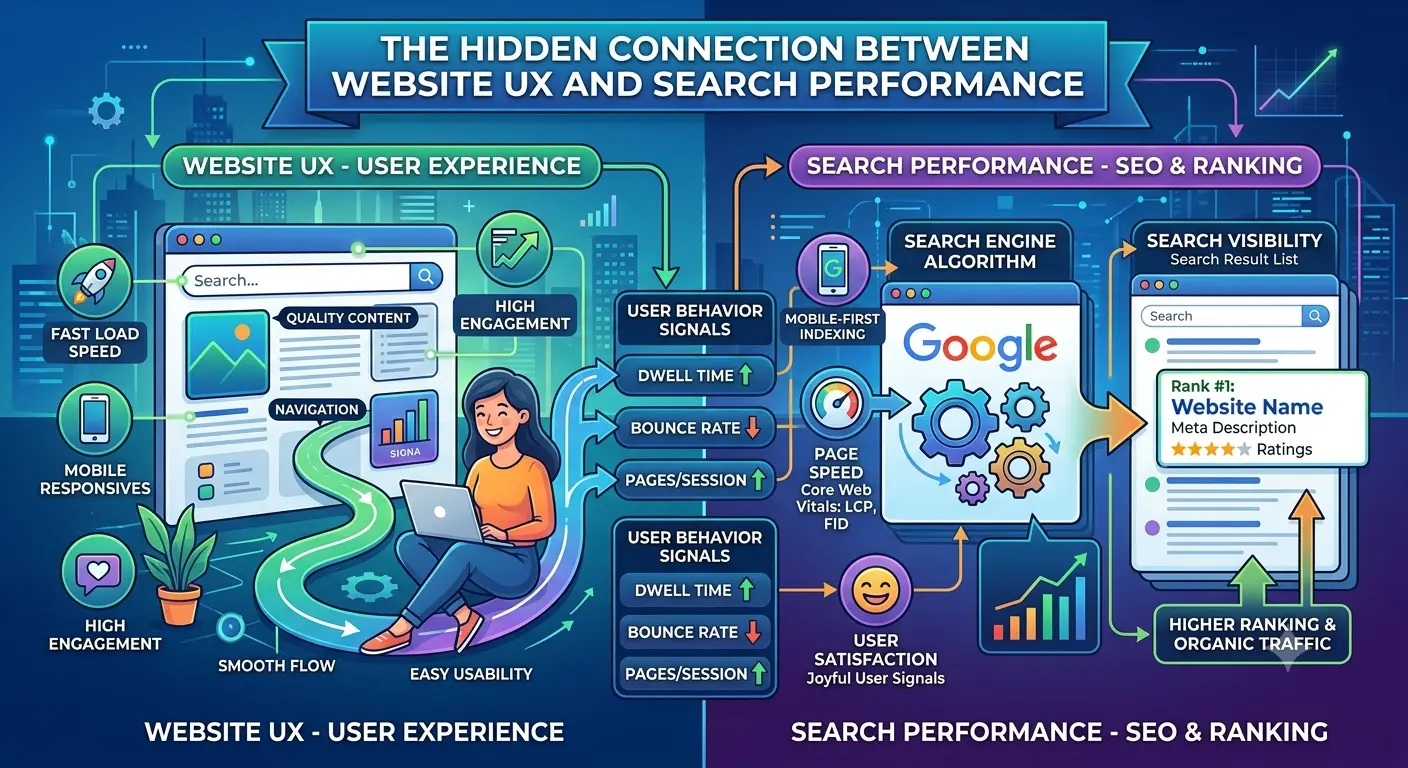
A website can have strong content, relevant keywords, and quality backlinks, yet still struggle to deliver good search performance. One often overlooked factor is the experience users have after they reach the website. Slow pages, confusing navigation, poor mobile layouts, and difficult-to-read content can make visitors leave before they find what they need.
This is where a digital marketing company in Kerala needs to look beyond traditional SEO activities and consider how website experience affects organic traffic and user engagement. Search visibility brings visitors to a website, but good UX helps keep them engaged and guides them toward the information or service they are looking for.
At Trivlogic, website development and SEO are treated as connected parts of a digital strategy. A well-built website should not only look professional but also load efficiently, work smoothly across devices, provide clear navigation, and make important information easy to access. When UX and SEO are planned together, businesses can create websites that are useful for visitors and easier for search engines to understand.
Search engines aim to provide useful results that satisfy search intent. While UX is not simply a ranking score that can be improved with a few design changes, several UX-related factors influence how users interact with a website.
A positive experience can encourage visitors to explore more pages, engage with content, and return to the site. A poor experience can have the opposite effect.
Important areas include:
For example, imagine a user searching for a service and clicking a result that takes ten seconds to load. Even if the content is excellent, the user may leave before seeing it. A beautifully designed page that takes forever to appear is still a beautiful waiting room.
Website navigation plays an important role in both usability and SEO. Visitors should be able to understand where they are and where they can go next without thinking too much.
A clear navigation structure also helps search engines understand the relationship between important pages.
A service-based website, for example, can organise its structure around:
Internal links should support this structure naturally. A relevant service page can link to a detailed blog, while a blog can guide readers toward a related service.
This is one area where web development services Kerala can directly support SEO goals. The technical structure of a website should make important pages accessible rather than hiding them several clicks deep.
A large portion of website traffic comes from mobile devices. A website that works perfectly on a desktop but becomes difficult to use on a phone creates an immediate problem. Users expect pages, menus, forms, and buttons to work smoothly regardless of the device they use.
Common mobile UX issues include:
Responsive design should ensure that a website adapts naturally to different screen sizes. Mobile usability should be considered from the beginning of the development process rather than treated as a final adjustment.
For businesses that also provide mobile app development services, maintaining a consistent experience across websites and mobile applications can further improve how users interact with the brand. Whether a visitor accesses a website through a phone browser or uses an app, the experience should remain simple, clear, and easy to navigate.
Speed is another important connection between UX and search performance. Visitors expect pages to load quickly, particularly when browsing from mobile networks.
Large images, unnecessary scripts, poor hosting configurations, excessive plugins, and unoptimised code can all slow down a website.
Improving performance may involve:
Technical improvements become more effective when they are planned during development. This is where custom web development can provide greater control over website structure, functionality, and performance.
SEO should not be added after a website is completely designed and developed. By that stage, fixing structural problems can require unnecessary redesign and development work.
A coordinated approach can address UX and SEO during the planning stage.
A digital marketing company in Kerala may identify search intent and keyword opportunities, while developers and designers build the website around those requirements.
Similarly, search engine optimization services Kerala should consider more than rankings and backlinks. Technical structure, content accessibility, internal linking, mobile usability, and page experience all contribute to the broader performance of a website.
The goal is not to design a website specifically for search engines. The goal is to build a website that works well for people while remaining easy for search engines to understand.
Website UX and search performance are connected through the way people interact with digital content. A fast, accessible, well-structured website gives visitors a clearer path from search result to useful information and, eventually, to an enquiry or purchase.
Good UX does not replace keyword research, technical SEO, quality content, or authority building. Instead, it strengthens the environment in which those SEO activities operate. A strong backlink cannot fix a confusing website, and a well-written article cannot do much if visitors struggle to read it on mobile.
For businesses investing in SEO and website development, these areas should therefore be considered together. Trivlogic focuses on creating websites where design, development, content, and search visibility support the same business objectives. When UX is treated as part of the SEO process rather than an afterthought, the website becomes easier to use, easier to understand, and better positioned to turn search traffic into meaningful business results.